MASTER AND COMMANDER

MASTER AND COMMANDER
ICONOGRAPHY OF GREATNESS

WELCOME TO A NEW APPRAISAL OF NAPOLEON

This blog is designed to show the real Napoleon, not the man disparaged by countless writers devoid of the facts who merely regurgitated the same misinformation either in blissful ignorance or in wilful spite.

BEHOLD A RISING STAR

BEHOLD A RISING STAR
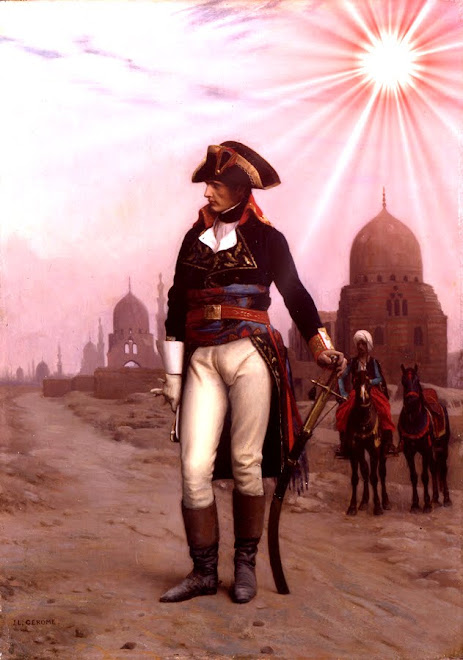
NAPOLEON IN EGYPT

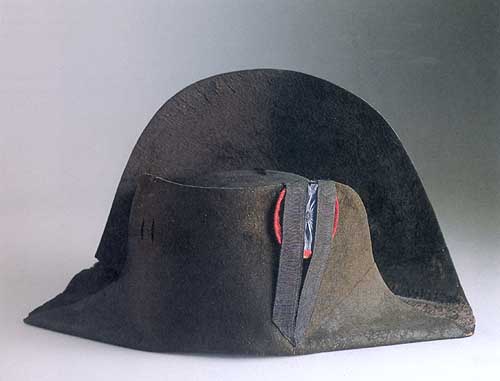
A FAMOUS HAT

A FAMOUS HAT
AHEAD OF THE REST

Tuesday, 19 June 2012

VIVE L'EMPEREUR! No.3


I am very pleased to announce the publication of the third edition of VIVE L'EMPEREUR! magazine. It is another tour de force by its editor Pascal Cazottes. It includes a fascinating article on Napoleon's last days on the island of Saint Helena and his murder by Montholon as well as articles on Oudinot, Napoleon's ill-fated son and Napoleon's own early military exploits between 1793 and 1795. The magazine has many rare and beautiful illustrations many from Pascal's own vast collection.

Pascal Cazottes Editor and Member of the SNI (Legion of Merit)


C. John Tarttelin 2012

A SOULADREAM PRODUCTION


Thursday, 14 June 2012

THE REAL NAPOLEON: The Untold Story - ILLUSTRATIONS

The past few days I have been choosing a number of illustrations for my book The Real Napoleon: The Untold Story which will be published by The History Press later this year. There are a vast number of images associated with Napoleon but most have been seen many times before. Often, the same couple of dozen are repeatedly used by publishers. I think I have managed to find some that are rarely seen in British publications and a few that might not have been seen before in books this side of The Channel. The Meissonier below is not one I have included but it is still a lovely image.


As a confirmation of the enduring fascination that Napoleon excites throughout the world, here is a recent story from June 11th 2012 in The Daily Telegraph in England:

SOLD, NAPOLEON'S ENGLISH HOMEWORK

"A rare letter in English by Napoleon has been sold at auction for £262,000, five times its estimate. The document went under the hammer in Fontainebleau and sold after a bidding war.

It was a homework exercise Napoleon sent to an English teacher for correction in 1816, while he was a prisoner on St Helena, and was sealed with the Imperial eagle wax stamp. The Osenat auction house said it was one of only three letters in English by Napoleon known to exist."

So, despite being beaten by Britain and the Prussians at Waterloo, and despite being an extremely reluctant prisoner on Saint Helena ( he had hoped for asylum in England's green and pleasant land ), the Emperor had the humility and common sense to want to learn the language of his jailers!


Here is another commonly used painting - but what a painting!

C. John Tarttelin 2012

A SOULADREAM PRODUCTION


Wednesday, 7 March 2012

BOOK REVIEW: NAPOLEON by GEORGES LEFEBVRE

NAPOLEON

Although Lefebvre was a Marxist historian writing in 1935-1936, his book is nevertheless the 'Great Man' type of work that the Marxist school were very much against. He wrote while Hitler was in power in Germany and there are conscious and subconscious allusions to the dictator throughout this book. He uses the Nietzschean phrase 'the will to power' several times in reference to Napoleon as if it was simply Napoleon's unbridled ego that led to the many wars of the early C19th. He lays the blame for war squarely at Napoleon's feet.

Few people realize that after Nietzsche died in 1900, his sister Elisabeth gathered together his unfinished notebooks and published them as The Will to Power: Attempt at a Revaluation of all Values. She was feted by the Nazis and told Hitler that her brother would have welcomed him and Nazis philosophy. Nothing could have been further from the truth. Yet the philosopher's views as espoused by his sister, were very much in favour with Hitler and his cronies. This support with such a highly regarded academic background appealed to the dictator's vanity. In return for this endorsement, Elisabeth became a virtual sainted grandmother of the Third Reich. However, she reinterpreted many of Nietzche's ideas and warped his views in order to please her powerful new patron.

Elisabeth inferred that her brother Friedrich would have been a supporter of Hitler's anti-semitism. In fact, Nietzsche ended his friendship with Wagner because of the latter's anti-semitism and spoke of the anti-semite as being the lowliest type of person - the exact opposite of what Elisabeth was saying to Hitler. The Nazi dictator's own philosophy of Social Darwinianism - that the strongest should survive and that the devil could take the hindmost  - could be bolstered by the now warped ideas behind the theory of the will to power, hence Hitler made use of it. Thus Nietszche became the so-called 'Philospher of the Third Reich' and has often been unfairly denigrated subsequently because of this.

Hitler persecuted and murdered the Jews - Napoleon gave them equal rights, and freed them from unfair restrictions throughout the territories under his control. And he was the first person to suggest that they should be given a homeland of their own in the Holy Land.

Napoleon was unlike Hitler, Stalin and Mao in other respects. Those three dictators eliminated all opposition. Despite repeated treachery from Talleyrand, Fouche, Bernadotte and many others, Napoleon did not have them executed. Indeed, he even invited Cadoudal - who have been plotting to murder him - to become an officer in his Army. Also, despite innumerable assassination attempts upon his life by D'Artois, the 'legitmate' heir to the vanished Bourbon throne, paid for by English gold, Napoleon did not respond in kind by trying to murder the British monarch.

Lefebvre goes out of his way to blame Napoleon for 'all the wars' and states that the Coalitions against him were only reacting to his plans of conquest - this despite the fact that Napoleon was usually attacked first by the other powers before he crushed them in battle. Neither does Lefebvre mention that after 1805, Napoleon could easily have deposed Francis of Austria; after 1806 he could have deposed Frederick William of Prussia - but he did neither; and after 1807 he could have really put the Tsar in his place - yet Alexander was treated incredibly leniently at Tilsit.

Lefebvre, despite his main Orwellian thesis i.e. 'Napoleon bad - Allies good', then goes on to describe Tsar Alexander's ambitions and empire-building plans and his unsated desire for more and more territory to add to his beloved Russian homeland. ( Long before Alexander, the Russians sent the Second Kamchatka expedition to Alaska from 1733-1743 and soon had vessels trapping sea otters off the Alaskan coast and subsequently down the Pacific Northwest as far south as California.) In fact, Lebevre goes into great detail about the Tsar's plan to attack France in 1811 - the very best and most detailed explanation of Alexander's treachery - when he was supposed to be an ally of Napoleon - I have ever read. This casts Napoleon's invasion of 1812 in a completely new light. In the end, both powers were determined upon war and it was simply a question of who could get their strike in first.

Lefebvre states that Napoleon wanted a quick battle in 1812 and then a new settlement with Alexander to ensure the success of his Continental System. Lefebvre's grasp of the economic, social and cultural aspects of this period in European history is superb - be it about Prussia, Russia, Austria, 'Germany' or even the minor states. His use of detailed records of imports, exports and trade statistics add to the fullest explanation of each powers diplomatic and trading status I have ever come across. His conclusion that England greedily viewed the seas as totally its own domain should come as a surprise to no one. He could have made more of the fact that with its command of the seas, no other power was able to grab as much land and as many colonies as the British, then and subsequently, even outdoing Russia in the end.

Lefebvre's Napoleon is an erudite and scholarly work that still reads like a novel - it is exciting, thought-provoking and stimulating. Certainly five stars.

Copyright 2012  John Tarttelin FINS 
A SOULADREAM PRODUCTION


Sunday, 19 February 2012

VIVE L'EMPEREUR No.2

I am delighted to announce that the second issue of VIVE L'EMPEREUR will soon be available in France. Edited by my friend and colleague Pascal Cazottes it covers many aspects of Napoleon's 1812 Campaign in Russia and the fate of the Grand Army. There are also articles about the young Napoleon and Dominique Jean Larrey, surgeon to the Imperial Guard.


Blog Copyright John Tarttelin FINS 2012
A SOULADREAM PRODUCTION

Monday, 30 January 2012

MY FRIEND PASCAL CAZOTTES

Pascal has a sense of humour and I was very pleased that he liked by little Gimped tribute to one of today's most prolific and distinguished writers in the field of Napoleonic studies. His articles on the SNI/INS website are superb and detailed and a real treasure for those blessed with the ability to read the French language. Pascal has recently been involved in the mammoth task of editing a new French magazine VIVE L'EMPEREUR. As a mere author I blanch at the colossal effort, intellectual ability and stamina required for such a task.
As well as being a brilliant writer in his own language, Pascal translated my article about Napoleon and the Tamboran eruption into French and included it in the very first edition of the magazine. He has also sent me many very rare pictures and images from C19th French magazines, and here are some of them:
NAPOLEON SHOWS THEM HOW


Napoleon never forgot that he was a gunner and he was forever showing his men how to sight the pieces, often under a veritable hail of shot and shell. On many occasions his soldiers begged him to retire but the Emperor retorted that the bullet that would kill him had yet to be cast. His physical bravery was a constant example to his soldiers, especially the young Marie Louises whom he relied upon in 1814. When a spluttering shell landed amongst some of them, Napoleon rode his horse over the shell. When it exploded, it did for the unfortunate horse but the Emperor scrambled to his feet, dusted himself off and smiled a silent "Eh bien!"

Crossing the Niemen 1812

Here are more of the pictures that Pascal has sent me. Some are impossible to place but they give a vivid image of the times.


Coignet at Austerlitz


Plan of the Battle of Borodino

Ben Weider
Ben founded the International Napoleonic Society. He was a gentleman and a great scholar and the world is somewhat lost and more empty without him. Pascal and I cherish his memory and, in celebration of his great life we try to maintain his legacy - Ben wanted to make sure that Napoleon's memory would not be tarnished and besmirched by poor historians and lazy historiography. We salute you Ben.
Mon ami Pascal

C. JOHN TARTTELIN FINS 2012

Friday, 13 January 2012

THE REAL NAPOLEON - The Untold Story

THE REAL NAPOLEON - The Untold Story
I am very pleased to announce that I have just signed a contract with The History Press who are going to publish my book later this year - the 200th anniversary of The Grand Army's invasion of Russia. It is hard to believe that two whole centuries have passed since those momentous days when the likes of Coignet and Bourgogne showed just what human beings could endure during the coldest Russian winter in a century.

Recently, in a branch of Waterstones I noticed that they were still selling Paul Johnson's character assassination of The Emperor. He blamed Napoleon personally for 'all the wars' which is complete nonsense. Alongside it on the shelves was Frank McLynn's book - readable - but he was far from a fan as well.

Yesterday, I watched a superb programme about Carthage and how it was destroyed and its very memory erased from the pages of history by Rome. For five hundred years Carthage had an empire when Rome itself was "Hicksville on the Tiber" according to the excellent presenter Richard Miles. Rome was jealous of the Carthaginian state and, more especially, of its immense wealth.

The Romans had no navy but in a bizarre turn of fate they discovered an intact Carthaginian vessel complete with builders' marks - so they were able to reconstruct the design 'to the letter'. Despite being massacred in early sea battles they later bested the Carthaginian fleet and took control of the whole of the western Mediterranean. But they also razed the city of Carthage to the ground and distributed salt so that nothing would ever grow there again. The population that survived the terrible fire as the city was taken were made slaves.

But the greedy, brutal and vengeful Romans went even further. They slandered and traduced everything the Carthaginians had ever stood for. They had burnt the magnificent library at Carthage so there was not even books or scrolls to 'speak up' for the lost empire of the Carthaginians. The Romans then said that the nobles of Carthage had burnt their own babies and children alive to appease their voracious gods and that they had perverted sexual practices. (Which is pretty rich coming from the Romans! Caesar himself tried to hide his homosexual dalliances as a young man). In short they utterly destroyed the memory of a civilization that had lasted for centuries.

I was instantly struck by the parallels with Napoleon and the British Empire. While he was alive, the English aristocracy and politicians spoke such a load of tosh about Napoleon to their own people and anyone else that would listen, that it is surprising they classed him as human at all - The Corsican Ogre was one of the lesser slurs used against him. It was said he slept with Hortense, his stepdaughter and other such scandals manufactured to belittle and degrade him. He was always drawn as a pygmy with a large nose by the caricaturists like Gilray and never given the status of 'the old nobility' and aristocracy in Europe. It was open season on Napoleon all year round. And, of course, Pitt and a cabal of degenerates in the Cabinet tried to murder him - a task they happily delegated to d'Artois and his creatures.

The first thing Louis XVIII wanted when he re-entered Paris in 1814 was Napoleon's personal fortune. The Emperor had been very careful with money, unlike his Bourbon predecessors, and the 320lb Louis wanted some to spend on his boyfriends.

The Carthaginians have had a bad press for two thousand years, but in the two centuries since Napoleon's death, hundreds of 'history' books have been written about him that are better fiction that anything written by Dickens or H.G.Wells. More books have been written about Napoleon than any other individual in human history. (I am very happy to add one more). Most of these books were anti-Napoleon diatribes that rehashed the same old twaddle and presented it as 'history'. In The Real Napoleon, I take many of them to task - it wasn't hard to show them as ignorant purveyors of lies and misrepresentation. In short, like in  Animal Farm they started with "England good - Napoleon bad" and went on from there. And, of course, what was the 'bad' pig called in that book - Napoleon!

Thanks to regular readers of this blog, it is getting an average of  50 hits a day, over 1,000 a month - so I know there are people out there who are prepared to make up their own minds and are not going to drink in the bilge served up by so many 'English historians'.  Napoleon was no saint, he made mistakes - sometimes bad ones, like the invasion of Russia itself - but had Austria and Russia lived up to the peace treaties they signed years earlier with him, there would have been no need for further conflict on the continent of Europe. But then again, there was all that English gold just ready for anyone who would attack France...

A belated Happy New Year to all readers of this blog - I shall keep you posted as to the publication date of The Real Napoleon.


C. John Tarttelin 2012